The Kanonkop Story: From a Signal Cannon to South Africa’s First Growth
Kanonkop is a family-owned wine estate on the slopes of the Simonsberg in Stellenbosch, often called South Africa's "first growth". The Sauer and Krige family has farmed it for four generations, from 1929 to today. It is famous for Pinotage, Cabernet Sauvignon and the Paul Sauer blend. The 2015 Paul Sauer became the first South African wine to be given a perfect 100 points by the critic Tim Atkin MW.
Where does the name Kanonkop come from?
In Afrikaans, kanon means cannon and kop means a small hill. In the 17th and 18th centuries, a cannon was fired from a hill on the Simonsberg above the estate whenever a ship sailed into Table Bay. The shot told local farmers to load fresh fruit and vegetables onto their wagons for the roughly 50-kilometre trip to the harbour, where they traded their produce with the ships. A cannon still appears on every Kanonkop label.
Who founded Kanonkop?
The story begins next door, on the Uitkyk farm, which politician J.W. Sauer bought in 1903. His son Paul Sauer was among the first students at Elsenburg Agricultural College in 1918. He began farming fruit and wine grapes on Uitkyk in 1921.
In 1929 Paul's mother sold Uitkyk but kept back its lower part, about 85 hectares of undeveloped land. That land became Paul's, which makes him the first owner of what is now Kanonkop Estate. In the same year he was elected to Parliament, where he served for 41 consecutive years (1929–1970), 16 of them as a government minister.
A cellar was built in 1942, and it is still the heart of the winery today. By the 1960s the farm had about 110 hectares of vines. At that time all of its wine was sold in bulk to Stellenbosch Farmers' Winery rather than bottled under its own name.
When did Kanonkop start bottling its own wine?
In November 1968, Kanonkop appointed its first official winemaker, Jan "Boland" Coetzee, a former Springbok rugby player. He replanted Shiraz vineyards with Cabernet Sauvignon. He also helped the estate bottle a small amount of Cabernet Sauvignon and Pinotage under its own name. The 1973 vintage was the first wine bottled under the Kanonkop name, and it was released in 1974 at R1.95 a bottle.
Paul Sauer died on 11 January 1976. His daughter Mary inherited the estate, and her husband Jannie Krige took early retirement to run it with her.
How did Beyers Truter make Kanonkop famous?
Beyers Truter took over the winemaking in 1980. The following year saw the first vintage of Paul Sauer, a Bordeaux-style blend led by Cabernet Sauvignon with Cabernet Franc and Merlot. It is now one of South Africa's most collected wines.
In 1986 the family stopped making wine for Stellenbosch Farmers' Winery and began bottling everything under the Kanonkop label. In the same year, Kanonkop became the first South African wine farm to sell wine en primeur, before release.
Then, in 1991, Truter was named International Winemaker of the Year at the International Wine & Spirit Competition (IWSC) in London. He was the first South African to win the title, and Kanonkop's Pinotage helped him win it. The award put both Kanonkop and South Africa's own grape, Pinotage, on the world map.
What did Abrie Beeslaar achieve at Kanonkop?
Abrie Beeslaar joined as Truter's assistant in 2002 and took over as winemaker in 2003. Under him, Kanonkop launched Black Label Pinotage, with a first vintage of 2006. It comes from a single block of dryland bush vines planted in 1953 and is now one of South Africa's most sought-after wines. According to the estate, Beeslaar won the IWSC winemaker award in 2008, 2015 and 2017.
The biggest milestone came with the 2015 Paul Sauer. Tim Atkin MW gave it 100 points in his South Africa report, the first time a South African wine had received a perfect score from him.
Who runs Kanonkop today?
Kanonkop is still family-owned. Brothers Johann and Paul Krige, Paul Sauer's grandsons, run the estate as its fourth generation. Paul moved to the farm in 1984, and Johann joined the family business in 1990 after working in export marketing at KWV. In 2022 Kanonkop bought the neighbouring Laibach property, now called Ladybird Vineyards.
In November 2024, Francois van Zyl became head winemaker, succeeding Abrie Beeslaar, who left to focus on his own label. Van Zyl is only the fourth winemaker since the first Kanonkop-label vintage in 1973, after Jan Coetzee, Beyers Truter and Beeslaar.
The winemaking has changed remarkably little. The estate's red wines are still fermented in the original open-top concrete fermenters, with the skins punched down by hand every two hours during fermentation. In October 2026, Kanonkop's Louw Strydom also joined the board of the Stellenbosch Wine Routes.
Kanonkop timeline
| 17th–18th century | A cannon on a Simonsberg hill signals ships arriving in Table Bay |
|---|---|
| 1903 | J.W. Sauer buys the neighbouring Uitkyk farm |
| 1929 | Paul Sauer becomes the first owner of the land that is now Kanonkop |
| 1942 | The cellar that is still in use today is built |
| 1968 | Jan "Boland" Coetzee becomes the first official winemaker |
| 1973 | First vintage bottled under the Kanonkop name (released in 1974) |
| 1980–1981 | Beyers Truter takes over; first vintage of Paul Sauer |
| 1986 | All production bottled under the Kanonkop label; first South African en primeur sales |
| 1991 | Beyers Truter named IWSC International Winemaker of the Year |
| 2003 | Abrie Beeslaar takes over the winemaking |
| 2006 | First vintage of Black Label Pinotage |
| 2018 | Paul Sauer 2015 receives 100 points from Tim Atkin MW |
| 2022 | Kanonkop buys the neighbouring Laibach farm (now Ladybird Vineyards) |
| 2024 | Francois van Zyl becomes head winemaker |
POTUM tip: to taste the Kanonkop style without opening a collector's bottle, start with the Kadette range. It is made in the same cellar, in the same open concrete fermenters, and is ready to drink young.
Which Kanonkop wines should you try?
All of these are available from POTUM, with delivery across Bulgaria and the EU.
-

Flagship blend
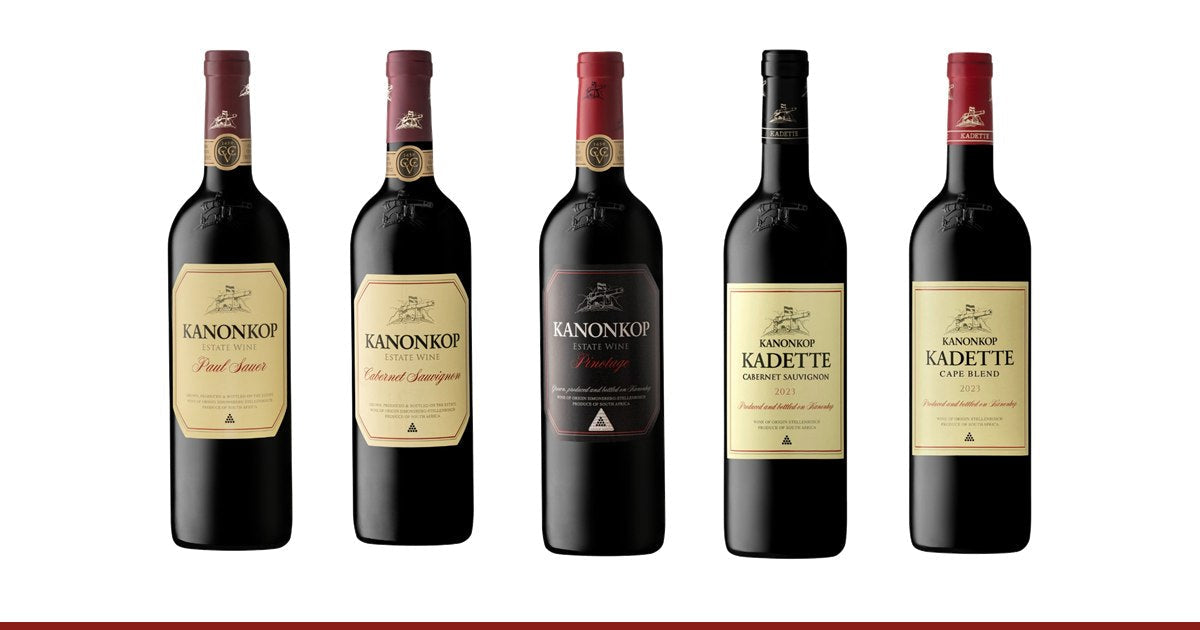
Kanonkop Paul Sauer 2022
The estate's Bordeaux-style flagship of Cabernet Sauvignon, Cabernet Franc and Merlot, named after the founder. It will age for decades.
View wine -

Icon Pinotage
Kanonkop Black Label Pinotage 2023
From dryland bush vines planted in 1953 and aged 18 months in new French oak. Only about 1,400 cases were made.
View wine -

Estate Cabernet
Kanonkop Cabernet Sauvignon 2020
Powerful and refined Simonsberg Cabernet, aged 24 months in French oak, with 10–15 years of ageing potential.
View wine -

Kadette range
Kanonkop Kadette Cabernet Sauvignon 2023
Ripe dark fruit and polished structure from Stellenbosch granite soils. Excellent everyday Cabernet with real pedigree.
View wine -

Kadette range
Kanonkop Kadette Cape Blend 2023
A Pinotage-led blend with Merlot, Cabernet Sauvignon, Cabernet Franc and Petit Verdot. Juicy, spicy and versatile.
View wine -

Kadette range
Kanonkop Kadette Pinotage 2022
100% Pinotage with cherry, mulberry and spice, matured in seasoned French oak. The best way to start exploring Kanonkop.
View wine
See the full range in our Kanonkop collection.
Frequently asked questions
What does Kanonkop mean?
Kanonkop means "cannon hill" in Afrikaans. In the 17th and 18th centuries, a cannon fired from a hill on the Simonsberg announced ships arriving in Table Bay, so farmers knew to take their produce to the harbour.
Who owns Kanonkop?
Kanonkop is family-owned. It is run by brothers Johann and Paul Krige, the fourth generation of the family and grandsons of Paul Sauer, who became the first owner of the land in 1929.
Why is Kanonkop called South Africa's first growth?
"First growth" is borrowed from Bordeaux's top classified châteaux. Kanonkop earned the nickname through decades of consistently outstanding red wines, international awards and wines such as Paul Sauer, whose 2015 vintage was the first South African wine given 100 points by Tim Atkin MW.
Who is the winemaker at Kanonkop?
Francois van Zyl has been head winemaker since November 2024. He follows Jan "Boland" Coetzee, Beyers Truter and Abrie Beeslaar.
What is the difference between Kanonkop Estate wines and Kadette?
The Estate range (Paul Sauer, Black Label Pinotage, Pinotage and Cabernet Sauvignon) comes from the estate's best vineyards and is built for long ageing. The Kadette range is made in the same cellar in a fresher, approachable style and offers excellent value.
Where can I buy Kanonkop wine in Bulgaria or the EU?
POTUM stocks a wide range of Kanonkop wines in Sofia, including Paul Sauer, Black Label Pinotage and the Kadette range, with delivery across Bulgaria and the EU.
Sources and further reading
- Kanonkop Wine Estate: Our Story, including the pages on Paul Sauer, Jan "Boland" Coetzee, Beyers Truter and the Krige brothers
- Kanonkop: Paul Sauer 2015 tops Tim Atkin report with first 100-point rating for a South African wine
- Decanter: Kanonkop announces new head winemaker
- Winemag: Change and splendid continuity at Kanonkop
- Winemag: Jean Engelbrecht appointed Stellenbosch Wine Routes chair